Author: alexanderchalkidis

  • Tim Cook fired, Siri ended and Apple buying it’s way out of AI trouble

    Tim Cook fired, Siri ended and Apple buying it’s way out of AI trouble

    Apple cannot innovate. Some of us have been saying it for many years now. Much like Elon Musk, they have a knack for bringing products to market. Not actual nuts and bolts. They buy those in and quietly integrate them. If you check out previous posts here you might want to change my label from “Apple hater” to “correct predictions“. I wrote about how their monopoly is hurting everyone, how they wouldn’t buy their way into AI (then) and how they are too lazy and set in their ways to change even though they need to. I wrote that Apple was never about technology and this is still true. It is too big to fail and too closely linked to the US economy for it to go the way of Nokia. But make no mistake, that is the way it’s heading.

    Apple has to buy in AI technology immediately. Anthropic, 11 Labs, Manus or any company making waves right now. Maybe focus on a UI for agentic interactions. Something. Anything. It isn’t only the technology that has leapfrogged ahead while Apple twiddled it’s thumbs over it’s iPhone cash cow. Most importantly Apple has no AI staffers other than the failed Apple Car team maybe.

    No two ways about it, Tim Cook is 100% to blame. Slow and careful steady management was great after Steve Jobs. Only that 1-2 years later he should have read the room. Artificial intelligence isn’t just the future. It’s the present. Generative models powering creative tools and machine learning optimizing everything from supply chains to personal assistants. And it probably won’t live on a little iPhone like brick either.

    Take Siri, for example. Once a fairly adequate voice assistant, it’s now the punchline of jokes about outdated tech. Truth be told it was never the best. A gimmick from the start while Google blazed ahead with constant innovation evolving robust, context-aware helpers. Siri still struggles with basic commands. Where’s the leap forward? Apple’s been touting “on-device AI” as part of its privacy first pitch, but that is looking more and more like an excuse. On device processing is great for security, but it limits the computational power needed for cutting-edge models that rivals are running in the cloud with staggering results.

    Then there’s the generative AI boom. ChatGPT, Midjourney, and other tools have transformed how we work and create. Microsoft’s Copilot is boosting productivity in Office, while Google’s Gemini is rewriting search. Apple? It’s nowhere to be seen. Rumors of an “Apple GPT” or AI-powered iOS features have swirled for years, but as of March 2025, we’ve got little more than incremental updates to photo editing and text prediction. That’s not innovation! That’s playing catch up with training wheels on. Apple should just give up on Siri and slap on Chat GPT. But can it? It has been so busy trying to tie everyone up to its hardware ecosystem it has forgotten how the tech world works: by connecting. Fast.

    The problem isn’t just execution; it’s vision. Apple seems allergic to the kind of bold, ecosystem-wide AI integration its competitors are embracing. Instead of reimagining how AI could redefine the iPhone, Mac, or even the Vision Pro, Apple’s sticking to its old playbook: polish the hardware, tweak the software, and call it a day. In an AI-driven world, that’s a recipe for irrelevance. Heck, it was falling apart even before Chat GPT decided to blow the world up with a completely premature release of AI into the wild. And that is exactly the issue with Tim Cook style Apple. Waiting to “make it safe” sounded cool but it’s more and more obviously a really bad excuse.

    Organizational Conflict: The Enemy Within

    If Apple’s AI lag was just a matter of tech, it might be fixable. But the real rot is structural. Apple’s famously secretive, top down culture is now its Achilles’ heel. The company’s built like a fortress, with siloed teams, rigid hierarchies, and a relentless focus on protecting its brand. That may have worked when Steve Jobs was steering the ship, but in 2025 it’s a liability.

    AI development thrives on collaboration, experimentation, and speed. You need cross-functional teams—engineers, data scientists, designers—working in lockstep, iterating fast, and learning from failure. Apple’s structure, by contrast, is a labyrinth of control. Reports from inside suggest that AI projects get bogged down in endless approvals, turf wars, and a paranoia about leaks. While Google’s DeepMind churns out Nobel winning breakthroughs and xAI pushes the boundaries of human understanding, Apple’s AI team is reportedly stuck debating whether a feature fits the “Apple aesthetic.”

    Then there’s the clash between hardware and software priorities. Apple’s DNA is in premium devices—iPhones, Macs, Watches—that drive its revenue. AI, though, is a software-first game, often requiring cloud infrastructure and open ecosystems to scale. Apple’s obsession with controlling the full stack (hardware, software, and services) means it’s reluctant to lean into the cloud or partner with others. That’s a structural conflict: the old guard wants to sell $1,000 phones, while the AI era demands a rethink of what “value” even means and maybe microcharge at different parts of the process. There is a reason your bank doesn’t use Apple servers. The company has self castrated itself before.

    Look at the Vision Pro, Apple’s big bet on mixed reality. It’s a technical marvel, but where’s the AI to make it indispensable? It feels like a shiny toy—impressive, but disconnected from the AI revolution that could give it purpose. That’s what happens when hardware fetishism trumps software ambition. Contrast it with Meta’s incredibly succesful Ray Ban AR glasses. Steve Jobs would have copied them last year for sure and sold it like something the world has never seen before.

    The Competition Isn’t Waiting

    Apple’s not just falling behind. It’s being lapped. Google’s AI first approach has turned its ecosystem into a powerhouse of utility. Google was predicting stuff for us to respond in Gmail before anyone knew Chat GTP even existed. Microsoft’s partnership with OpenAI has made it a leader in enterprise and consumer AI. Even Tesla’s pushing AI into physical products with autonomous driving and robotics. These companies aren’t perfect, but they’re moving fast, taking risks, and reaping rewards.

    Apple, meanwhile, seems content to rest on its laurels. Its $3 trillion valuation is a testament to past success, not future potential. The iPhone still prints money, but growth is slowing. Analysts note declining market share in key regions like China and let’s be honest, Apple is only relevant in America in terms of market share. Without a compelling AI story, Apple risks becoming the Nokia of the 2020s: a once dominant player blindsided by a paradigm shift.

    Can Apple Turn It Around?

    Hiring top AI minds (probably through acquisitions), loosening its grip on control and embracing a bolder vision could get it back in the game. Imagine an iOS powered by a world-class AI assistant, or a Mac that anticipates your workflow with generative tools. But that requires a cultural overhaul and Tim Cook’s steadyhand leadership hasn’t shown the stomach for it. Incrementalism won’t cut it when the ground is shifting this fast.

    Apple isn’t dead yet, but it’s on a troubling trajectory. Its lack of a coherent AI strategy leaves it exposed in a world where intelligence, not just design, defines tech’s cutting edge. Worse still, its organizational conflicts—born of a bygone era—make it too slow and rigid to adapt. It can’t disappear because it is built into the American economy. But it is looking dumber and dumber by the day. I called it years ago and I will be here to gloat again in the future.

    No AI needed to guess that.


  • Dirty secrets of the Mediterranean diet

    Dirty secrets of the Mediterranean diet

    Last summer it seemed as if half of America came to Greece.  To be more precise to Athens, Mykonos and Santorini.  To me that seems rather counter productive as Greece has numerous better, cheaper, more original locations to visit.  But that is nothing compared to the irrational things I see and hear concerning Greek food.  Now don’t get me wrong, we have all read about the benefits of a Mediterranean diet.  And it is mostly delicious.

    But is it nutritious?

    Greek salad is a great example. We had no tomatoes until well into the 1900s!  Much later than the rest of Europe they were introduced to Greece and even then they weren’t in wide circulation.  So how on earth is a salad based on tomatoes “traditional”?  In fact it was invented in the 1960s by the restaurants around Plaka, just under the Acropolis, clearly a practical solution for a quick, cheap and high margin food for tourists.  And then look at the contents, feta is extremely high in fat and most people use half a loaf of bread to dunk in the (supposedly nutritious) olive oil.

    But how would a real scientist measure the true nutritional content of a Greek salad?  Even the most seemingly simple item in it is in fact extremely complicated.  Olives are ultra processed food.  They aren’t just plucked off a tree and put in your salad.  They are washed, marinated, rinsed many times, marinated again, left in salt water, rinsed…you get the picture.  When scientists say that olives are good for us are they referring to the fresh ones off the tree or some version of these post-processed ones like the ones we actually eat?

    It seems we have a most serious problem in defining foods and nutritional content.

    The most extreme example in Greece is “horta”.  It literally means “grass” and refers to a variety of vegetation usually plucked from the side of the road like dandelion.   Again, this is a fairly well studied plant in its wild, natural state.  But because it is extremely bitter, during the second world war famine, Greeks were forced to eat it for lack of anything else being available.  In order to make it palatable they rinsed, boiled, rerinsed, marinated and doused in oil and lemon.  It really isn’t edible anyhow else but from a nutritional point of view I would guess there is less than 10% chance it contains anything at all other than fiber.  Which is to say it is like eating cardboard.

    Since many reputable sources insist on promoting the Mediterranean diet it seems that such research is extremely important.  I don’t see American tourists eating much of the legumes mentioned in the literature.  Nor the fish since the Mediterranean is critically overfished so even if you do ask for fish you are likely to get frozen or imported ones.  At best cultivated fish from Greece maybe, 2-3 species mainly with all the health problems of that category.    If anything when tourists rave about “Greek food” they are referring mainly to the starters, a mixture of Eastern hits, heavy in fats, saturated fats and ridiculous amounts of calories.

    It is not enough to vaguely refer to diets of a region.  Nor to specific foods.  We need updated, extremely specific measurements of nutritional content as soon as possible for a whole lot of food generally considered “healthy” by millions of people that have absolutely no way of measuring it.


    (Feel free to object to anything here but please include references to actual scientific studies if you do. And even then, scientific studies on the actual end result, ie food we eat, not potential benefits from likely ingredients in vitro and in ridiculously high concentrations or forms we will never get on our tables.)

  • The Apple Paradox: How they are hurting all of us

    The Apple Paradox: How they are hurting all of us

    I remember getting my hands on the first iPhone. “So where is copy-paste?” I asked. Oh, I was “ignorant” and “not aware of best user interactions principles”. Sure, whatever. A few years later, iPhones had copy-paste of course. Or the Mighty Mouse, a revolution (according to Apple) which introduced…the right click we all had relied on for decades already before their big announcement.

    And now…the magic button on the iPhone. This isn’t business as usual, nor should we let them get away with it again. Apple is a company whose outsize effect on user interface it is time we all question. Sure they control more than half the smartphone market in the United States. But that’s about it! And even there, somebody should grow a set and state the facts.

    Apple, we have had enough of your pointless changes. You want a super thin MacBook? Go ahead, leave it with just one USB port. But don’t expect everyone to follow just because of your multimillion advertising prowess. You want to remove the iPhone’s multifunctional home button? Be our guest, but what do you have to say now that you are bringing it back?

    The problem is that Apple has an effect on everything. And it shouldn’t. Because they really are not the best at UI. Not even close. Their criteria is not the best user experience but how to sell more iPhones. They add and take away ports in order to sell more dongles, adapters or their new accessories. It is all about, and only about, their bottom line. They are making fools of all of their users and it’s about time you wised up to this fact.

    Tweaking the Bluetooth protocol to make it different and weird and incompatible isn’t clever. It costs the entire planet billions in waste. There are international consortiums where these things are discussed and agreed upon precisely because we need our stuff to work together for as long as possible, as easily as possible and as widely as possible. Apple is laughing in the face of its users in the most disrespectful way possible too. Adding two buttons to your daily phone isn’t funny. There is a learning curve and a massive cost all the way up and down the chain of everything around the iPhones.

    It’s not just iPhones. We have all suffered greatly from every “weird” choice Apple made these past decades. Even when we don’t use Apple products. It affects everyone. They weren’t weird for any other reason than profit. The DoJ is right. Apple has made something worse than a walled garden with iOS. It is a dictatorship that demands payment every few years in the latest Apple products.

    Free market. You can choose to stay within that garden. But don’t pretend that it is the cutting edge of technology. Nor the best design choices. It is costing the entire planet to look at Apple as anything else than an extremely selfish niche company playing dictator.

  • The best time of year to visit Greece without ruining the planet

    The best time of year to visit Greece without ruining the planet

    If you have booked a holiday in Greece for June, July or August you have made a big mistake. Unless you are heading for the mountains in the North you are in for multiple unpleasant surprises.

    In this post I described the horrors of visiting Santorini. And that was at the end of October! Many people recommend September as the ideal month in terms of weather. They lack an understanding of Greek tourism. It is mainly small business, family run or short termist approaches. By September they are exhausted, they are sick and tired of tourists. Even the beaches, even if they are empty feel used and out of energy. Maybe you can’t see rubbish, but you can feel the presence of thousands that packed the sand before you.

    Severe heat presents a problem on multiple fronts. First of all you can’t really do anything. Running from shade to shade is no way to live unless it is a dystopian movie. When the heat is unbearable even in the evening you are reduced to sitting in the room with the AC on and jumping in the pool briefly with multiple lotions slathered on generously, hats, umbrellas and any other available technology against skin cancer.

    But it gets worse. Because those ACs are simply pumping out more heat and noise. We have just moved the problem beyond sight. And Greek islands have no sustainable energy sources. So if you drive around you will usually find a petrol burning electricity station producing inefficient quantities of power. Which is why even Santorini often is left without power.

    And without water. Greek islands barely had enough water for their few inhabitants a hundred years ago. Now they have to carry it over from the mainland and truck millions of bottles of it for you to drink. And forgoing all the problems of the energy demanded for that, they all also end up in landfills. Like the famously hideous one in Santorini. Every Greek island has one, some islands actually export their rubbish in trucks that get on the boat with you. It is a ludicrous reminder of just how unsustainable this is. Getting millions of people on a little rocky island.

    But wait, it gets worse. Because as is well documented, severe heat also increases the chances of forest fires.

    These past 3-4 years in Greece have been devastating. Personally I blame the current government which has dramatically changed the approach to fire fighting. They also do not enforce any measures to reduce fire hazards, always pretending to pass responsibility to citizens.

    And that is Greek tourism in a nutshell. An important sector of the economy which relies 100% on the ability of the State to provide infrastructure:

    1. Power Infrastructure. A joke. The government brags about wind energy which is produced by destroying Greek mountains. At the same time power cables are overland! They destroy your pictures as a tourist and they greatly increase the fire risk as most wild fires are started by faulty electric cabling. (And then everyone pretends it was arson.)
    2. Water infrastructure. Non existent. And given the fact that tourists stupidly keep going to the same few islands it is a hard one to solve. This isn’t just about the water you drink, it is even more so about toilet waste disposal. For too many years the easy solution was just a pipe going out to sea. This is still often the case.
    3. Waste infrastructure. Greece just keeps getting fined from the EU because we recycle less than everyone else. Landfills are disgraceful and largely unregulated anarchy.
    4. Communication infrastructure. The most expensive in Europe for most things (mobile and fixed line internet) and far behind in terms of available speeds. So much for being a digital nomad.
    5. Transport infrastructure. We Greeks don’t even think of getting on a boat with our cars to go to an island. Prices have rocketed as it is essentially monopolies of government cronies. There is no rail network and prices of motorway tolls are out of control. That is usually motorways built on government loans and european funds, somehow we end up paying them back in tolls for decades…
    6. Tourism infrastructure. Closed! This may sound crazy but most Greek antiquities are free to visit. Free to loot. Completely unprotected, often without even a fence to pretend we care. The Greek government seems to focus only on public relations campaigns like the one for the Elgin marbles, or on opening new museums which then get abandoned. Due to lack of staff they are often closed. Or open severely restricted hours. Or closed due to strikes. But the real problem is the lack of information. You drive along and see a fantastic ruin but there is no information anywhere about it.

    But please come to Greece. It is still one of the most beautiful countries I know. Just don’t “do” Mykonos, Santorini and a quick run up the Acropolis. Come in April or May if you like the sea to find fresh beaches and locals that are still happy and energized. Go to smaller islands or – better still- thousands of kilometers of great beaches that are off the mainland. Come any other period other than the summer months and enjoy antiquities, nature and (depending where you go) great people that generally speak English and are very hospitable.

    A friend once told me that “tourism destroys all it touches”. This is true of much of Greece, more now than ever before. So be careful where you touch.

    PS All the images on this post are from the Acropolis of ancient Siphai. One of thousands of important archaelogical sites left to crumble (literally) in Greece. So come quick and see them at least. Good luck learning more about them, here is the official Ministry of Culture page on this site:

  • Do no evil: ranking tech giants

    Do no evil: ranking tech giants

    Meta for sure is the most evil large technology company of our times.  It is at heart the extension of an extremely immature mediocre hacker.  Time and time again proven unreliable or just straight lying to everyone’s face.  Even if we accept that it has grown so much that it is now difficult for Facebook to act as bad as it used to, we know it will try.  How?  It’s the little things every day.  The lack of resources in policing content.  The experiments are still running on users all the time.  The lack of transparency.  Heck you can’t even export your data normally, they keep trying to hide deactivation menus or make not accepting cookies harder than they should.

    Mark Zuckerberg doesn’t want to connect people.  He just wants to connect your wallet to his bank account.  Plain and simple.  Facebook and Instagram are the crack cocaine of our digital world and he is always looking for ways to make them even more lethal to our psychological well being and social cohesion.  There is simply no upside to any of Meta’s products.  And even if there was some social aspect to them it is submerged in constant changes and lies of the platform.  One minute they are promoting facebook pages, get everyone to invest in those, the next they have relegated them and nobody sees them in the newsfeed.  Then it was video, the future of everything, go build studios in your companies….oh no, he ended that too without warning.  Nobody should take anything Meta says seriously anymore.

    Microsoft is of course evil but in a more traditional way.  This is old fashioned monopolistic behavior.  They build their products in all the ways they can to lock customers in.  Not as bad as Meta because after all this is the software that runs a lot of the planet’s infrastructure and day to day business.  But they do their best.  Complicated pricing structures that get you started and then hold you by the balls.  Lobbying to governments with shady deals that turn into long term locks.  They open up when they lose, like with mobile phones, just enough to try and keep a finger in every pie.  Just so they can weasel their way into your company’s backbone and get you paying a monthly fee for something or other.  And somehow that monthly fee grows over time.  They always find a way.  Microsoft is evil on a state level of lobbying and backroom dealing.  But at least they also get stuff done for the planet and occasionally actually improve their products.

    Google is much harder to consider evil because of the extremely unique business model.  Billions of people around the world have never ever paid Google a cent yet they use Google products all the time.  Google Maps, YouTube, Search, Docs, Android and other incredible and unique tools that are completely free.  Unlike what conspiracy theorists try to tell you, free means free.  In ten seconds you can get a Google account, 15GB for free and do absolutely amazing things on your phone, tablet or computer.  Google is what I call a benevolent dictator.  Sure, they could destroy the planet at any time.  They could ruin all of us.  They probably know what will happen a few years in the future better than anyone.  But they don’t.

    Chat GPT is an excellent illustration of this.  The “T” in GPT of course being a Google invention that the company gifted to the world.  Google could have released something similar a long time ago.  They didn’t.  The kind dictator knew it was too soon for humanity to handle it.  

    Apple shouldn’t even be on this list because it isn’t a tech company.  A giant yes, tech no.  Apple doesn’t innovate technologically.  It is a lifestyle company.  More importantly it is a staple of the American economy.  Much like the dollar.  Apple sells mainly in North America and doesn’t even bother to accommodate the rest of the planet in product design or support.  They make products with last year’s tech copied from everyone or from companies it buys out.  It makes “good enough” gadgets with the design language it has found works for it.  It’s financial success has nothing to do with any groundbreaking technology. Banks don’t run on Macs and neither does anything else of any consequence on the planet.


    So stop lumping “tech giants” in articles and opinions.  They are nothing like each other.  Sure there are product categories where they conflict.  But it is completely irrelevant.  The business models and the way they look at the world is so different that they should hardly ever be in the same sentence.  Some of us, the people that really try to think about technology, society and business care about these differences after all. Show some respect.

  • Apple can’t buy it’s way into AI

    Apple can’t buy it’s way into AI

    Have you heard of Google Crowdsource? It’s been around for years,

    a lot of volunteers helping Google become even better at AI. Thousands of people doing image label verification, or audio validation, handwriting verification and millions of other clever ways to help Google improve. I am Level35 because I found it interesting from the start. I enjoyed the tech talks from Google AI people and the seminars. You know, back when AI wasn’t all the rage like it is now.

    Or maybe you have heard of Google Photos. A ridiculous in scale endeavour whereby Google gave the entire planet (after all 8 out of 10 smartphones run on Android, not iOS) infinite photo backup. Thus sucking up the greatest free database of images anywhere. Ever. While iPhone users all have phones out of storage because they don’t want to pay anymore than they already pay every month to Apple.

    These are just two examples that you might not have thought of. Of course Google Maps, YouTube or Google Search are also on a scale way beyond anything Apple can even imagine. This isn’t like Siri, Apple can’t just throw 200 million to buy an SRI equivelant to catch up. In fact Siri is an excellent example because even when it was launched it was many years behind Google. Much like with Apple Maps, Apple seems content to have an inferior product simply window dressed for the North American market.

    Google has invested long term in making Google Maps a globally relevant product. There has been a vibrant group of contributors adding to the quality of the data and the AI. Apple has been too busy trying to upsell devices at a greater profit margin to bother to improve its products. Some say it’s the “dark horse” playing “the long game”. They are ignorant and almost funny in their ignorance.

    It isn’t just about massive datasets. AI focus has been at the core of Google’s existence from the get go. Converting Google search to Chat GPT like functionality was just the flip of a switch for Alphabet. They didn’t need to buy any companies because they are that company. And if it is about computing power again Google has the best model. They have been selling “free” services like search, maps, youtube and everything else for years, building massive infrastructure on the back of their ad business in ways that consumers consider a win win.

    Apple’s endeavours in digital video creation are an excellent illustration of the extent of the hole they have dug themselves. A few decades ago the company thought that digital video creation would be the next DTP, the next saviour for their computing division. Even now with their touted advantage in processors they have just 20% of the global computer share. Back then they bought software like Final Cut and other more expensive digital creation tools and tried to package them in various ways to sell more Macs into studios and broadcasters. It didn’t work of course. Apple was not that kind of company, it made money from iPhones. There was no durability to the vision and the software started dying out with less and less updates. It went back to being a cute toy for some Apple loving film folk.

    Right now Apple has no AI vision. It can’t even think of how to develop one. They are too busy trying to think of some gadget that will sell as the iPhone’s market share which is puny. For all you Americans reading, globally just 15% of humans use an iPhone. They all prefer products that are more affordable, more flexible, more open and with the innovations that Apple copies for their next flagship every year. They haven’t been beating world champions at the game of Go, nor folding proteins.

    So when Apple inevitably announces what its plan are in AI, I would take them with a massive pinch of salt. Buying any company won’t solve their problem and no new technology they can announce will either. AI thinking is a long term project and Apple has been absent from the party.

  • I did the one thing Facebook simply can’t handle

    I did the one thing Facebook simply can’t handle

    And I got murdered (on Facebook) for doing it.

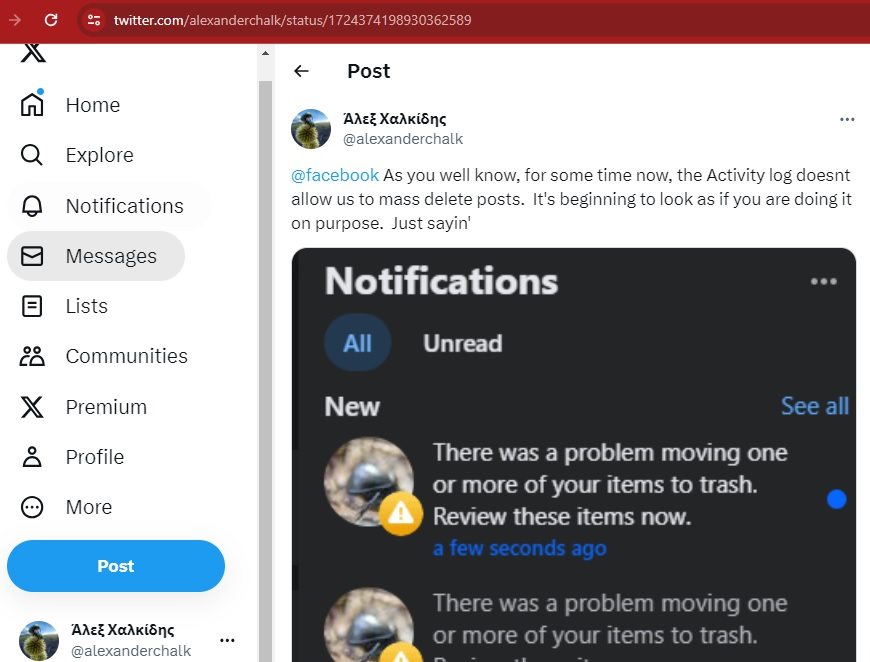
    We all suspect that “deleting” anything on Facebook doesn’t really delete it. Our personal information is way too valuable. So hiding, archiving and any other option doesn’t really cut it. Under pressure from the EU and everyone else, Facebook finally provided a way to delete your activity. Of course they hid it in complicated menus which they keep changing.

    But worse still, it doesn’t even work.

    I know because I regularly delete all my facebook activity. I also regularly delete all my Instagram photos. It used to work, now it doesn’t. I resorted to writing a bot to do it “manually”, ie to go and delete everything one by one from my smartphone as if it was me doing it. Obviously Facebook doesn’t think anyone will have the patience to do it like that.

    And what happened when I went to Twitter to complain about it?

    They suspended my account. With no recourse to recovery according to them. That is how scared they are that more people will follow my example. After all I have always said that it is ludicrous to rely on Facebook or Instagram as a place to keep anything important. Right from the day they started I advocated basing your communications on your website so you can control it all best.

    And own it.

  • Security is a personal choice

    Security is a personal choice

    Just got off chat support with N26.  It is one of those online banks like Revolut or Wise.  Only it isn’t.  Because it has everything annoyingly Germanic about it as humanly possible.  My feedback at the end of my ordeal (to change the phone number I have declared) was “just copy everyone else”.  To which they – predictably – responded that they give great importance to security for the good of everyone, blah blah blah.

    It’s not “everyone” with the account.  Just me.  And I use it for small change.  I don’t care if someone hacks it easier, that is how I have it in my head.  “Not much money=not worth a lot of security”.  Makes sense to me.  Not just for banking, for everything.  If you are heavily invested in Facebook sure, go ahead, have two factor authentication or whatever else you want.  If you don’t care, why bother?

    It isn’t just because I am a liberal who believes in choice.  It makes business sense too.  By all means dream up of extra security.  Make it available.  Advertise it, explain it, heck you can even charge extra for it.  But it makes zero sense for the same high level of security to be compulsory for everyone.  This isn’t a physical bank where one thief getting in will risk everybody’s money.  This is my personal account. I should be able to choose how to verify what. I might like to sign in from new devices easily. I may not want to rely on a phone for SMS verification. My choice!

    I can blame the media.  They love to make a fuss about online hazards.  I can blame security experts, always exaggerating and talking about crazy breaches they have witnessed which most of us will never get close to.  I can blame human nature, some people are security crazy and then try and force it down the neck of the rest of us.  And when something goes wrong with security everyone jumps to conclusions and takes the opportunity to increase it with more security.

    Enough is enough though.

  • The best holiday of my life isn’t available to 99% of you

    The best holiday of my life isn’t available to 99% of you

    Here is how it goes: wake up early, before the Greek summer heat.  Get out of bed, put on your boots and walk.  I usually leave breakfast until the first uphill is over or until the first spectacular view.  Everything tastes better when you are surrounded with beauty.

    My schedule for this morning is , well, to walk.  That simple.  Minimal as it gets, it is meditation at it’s purest.  One path, one direction, two legs.  I walk until it is too hot, by which time – if I got my planning right – I am in a quaint Greek mountain village taverna.  Wash, drink, eat, relax, maybe even take a siesta, play some card games to kill time until the afternoon when my son says the UV index is ok to walk some more.  You really get to know a place when you spend so many hours there midday. Then more path pleasures until the sweet dusk.

    This is the best holiday because it is the most efficient.  I am wasting no time looking for parking near the beach or waiting for a waiter to bring me a cocktail.  I don’t have to “get back” to the room to prepare for a night out.  I just stop walking, have a light dinner if I feel like it and climb in to bed for the best sleep of my life.  I walked 200 km in a week and yet every morning I woke feeling more relaxed and stronger than the day before.  A friend who walked with me last summer claims that even now – a year later – he feels energized by the memory alone.

    This is the world of long distance trail walking.  Unfortunately it is completely inaccessible to most people.

    Please don’t imagine I am some die hard mountaineer or wild man who only hikes.  I have enjoyed the best boutique hotels on the planet, traveled to more than 40 countries and tried every kind of holiday.  From cruises in the Caribbean to luxury yachts and from the top of Kilimanjaro to road trips in California.  From the joys of all inclusive resorts to historic tours of Syria (before the war destroyed everything I was fortunate enough to see.)   No, the reason you can’t enjoy long distance trail walking is because there is no infrastructure for normal people.

    Tourism is one of a few activities that require government regulation.  I am as liberal as they come, I don’t believe in big government.  But like my friend Charles from the sea turtle protection society said to me 40 years ago “tourism will destroy everything it touches if you let it.”  I am doing it my way and it is illegal, risky and takes years of practice.   It shouldn’t be this hard.   For starters I am sleeping outdoors wherever my day ends.  “There are wolves up there!” warned the locals.  I have no idea if they were exaggerating.  I slept fine.  Another night it was by a church, just in case it rained.  The next to an abandoned building site because we were too late leaving the village and that was the best we could find.  Most of the time it is in the middle of nowhere, forest, peak, whatever.  I can do that because I have spent most of my life exploring. Nobody else should have to gather 53 years of experience in order to get a good night’s sleep.

    So here is my plan:  convert the hundreds of abandoned churches that litter the Greek countryside into makeshift hospitality stations.  Don’t even open the can of worms that is allowing free camping (currently illegal in Greece), focus on making it easier for people with no wilderness knowledge to just walk. It is a bit like “bed and breakfasting” in England.  You just need to reach the next little church to find something to eat, something to drink and a place to rest.  Churches are already in a legal loophole.  It could easily be expanded to include basic accommodation, preferably non permanent structure, possibly even traditional ones, a kind of glamping.  (The “vlahoi” nomads even have their own reconstructed tents in a few places now and are quite trendy, think of it like a yurt with a twist.)    Theoretically you are not allowed to build anything in forest or mountainous areas in Greece.  In practice people freely bulldoze roads wherever they like, graze whatever animals they won’t anywhere and dump rubbish of every kind even at the most remote places.  Getting more tourists there would serve to protect the countryside.

    The closest real life example we have in Greece is mount Olympus where a network of mountain refuges serve to make it easier to scale the spectacular peaks of the Gods.  It is a monumental effort kept together by a shoe string and a lot of effort on the part of the heroes up there.  Thousands of visitors enjoy a beer and Greek salad in almost hotel level services at an altitude of more than 2000meters.  We know there is demand.  It is currently restricted by the draconian and highly hypocritical Greek laws about wildlife preservation which only seem to have two conditions:  either nothing is permitted or everything is.   Big mountain ranges need something better than that.  They need a management plan.  It’s not rocket science, it started with the big US national parks and all over the world we now know how to do it.  

    I can’t pretend to be able to solve this in a day.  But the plan to convert abandoned remote churches into accommodation centers for long distance paths can be implemented immediately and easily and will instantly help divert tourists from getting bored on beaches.  The modern tourist wants to actually do something, they want the feeling of achievement, something Instagramable.  You can walk to lose weight or to meditate.  You can walk just to say you walked X miles, you can walk for charity.  You can walk to reconnect with old friends and chat along the way or to meet new ones.  The fact is that millions of people around the world are on a treadmill right now paying more for their gym membership than the church would be charging them.

    Get off the treadmill.  Come to Greece and walk a long distance path with me.

  • The perfect day in Santorini (you don’t need a second one)

    The perfect day in Santorini (you don’t need a second one)

    It has featured in lists named like “Top 100 things to see in your lifetime” or equally click bait sounding titles from prestigious travel magazines.  Half a volcano submerged, leaving a magically enchanting scenery which is truly breathtaking. But spending more than a day or two on Santorini is simply stupid.  Here are the things worth doing, they all fit in a day:

    1. Of course the sunset at Oia overlooking the caldera is magical.  Unless there are too many people which is of course what happens at sunset.  In fact it happens all day long at popular Instagramable photo spots.  And try not to notice the rubbish which is everywhere even off season, you would think somebody would care but they don’t.  In fact there is a huge rubbish dump with the same view!
    2. The paths from Pyrgos to ancient Thira and Perissa, preferable with a sunrise included as they look East.  Everybody raves about the sunset, unfortunately the idiots that run archaelogy in Greece keep sites closed instead of making it a thing.  Signage is mediocre and the local buses a joke if you want to get back to where you started somehow.  But you will get to see Pyrgos and Emporeio which are pretty and slightly less destroyed by tourism.  (Which isn’t saying much.)
    No alt text provided for this image

    (Sure you can walk along ancient paths in Santorini. So do idiots that hunt little birds with no repercussions or control.)

    Here are the things NOT to bother with:

    1. The pathetic boat trips to the pretty miserable “volcanic” island.  A desert rocky walk with a few smelly gasses and an equally disappointing swim in cold water which is slightly warmer here and there.
    2. The famous Akrotiti buried ancient city.  An incredibly important site which would be interesting if they hadn’t completely ruined it with the new cover and structure.  I was lucky enough to walk in it with the older arrangement and it was infinitely more exciting.  Now you just look over it and we weren’t even allowed to go down to the old city level “due to lack of staff”.  If you do go, make sure to go to the equally disappointing museum of Prehistoric Santorini first so you at least get to see all “the good stuff” which they didn’t leave at Akrotiri.  Strange how Greeks keep going on about the Elgin marbles being in London as they do exactly the same thing to all their antiquities, sending the most important finds to Athens or other more central museums.
    3. Pretty much anything else anywhere on this horrible island.  Terrible roads run through a poster child of how tourism completely destroys an area.  Complete anarchy with rooms, villas or any other description of places to stay a night thrown anywhere they can, rubbish everywhere and a barren scenery with none of the magic of the Cyclades.
    No alt text provided for this image

    (Donkey dung, rubbish and one hell of a view: Santorini in a nutshell)

    I would not put Santorini in my Top10 best Greek islands to visit before you die.  Probably not even the top20.  It is an environmental disaster with no water or power supply of its own, no infrastructure for the huge amounts of rubbish or other waste. In fact power and water outages are common in the summer. A day excursion from a cruise ship is more than enough to see the caldera.  Move on after that to somewhere worth your money and time, somewhere without people that have such a short term approach to tourism.  In many ways Santorini is the perfect illustration of modern Greek tourism.  Everyone we spoke to, over worked, underpaid employees crammed into terrible housing and getting paid 600-700 euro a month, marvel how the tourists keep coming.  A small dose of tzatziki can set you back 9 euro or more and room prices are even more crazy. 

    The whole premise of visiting this island hangs on a shoe string thanks to it’s one saving natural grace, the only thing they can’t destroy.  So come see it before they find a way to ruin even that.